This week on Thursday 7th May, we celebrate National Dinosaur Day. here in Australia. Queensland celebrates National Dinosaur Week beginning Monday 4th May. The U.S. celebrate national dinosaur day on 1st June, while International Dinosaur day is 20th May. I thought this was a perfect time to revisit some of Australia’s unique dinosaurs and of course my chapter book Fossil Frenzy the Adamson Adventures 3.
I know I promised I would write this month on the Realities of Self-Publishing part 3, but I hope you forgive me in my indulgence of our incredibly roaresome extinct wildlife.
Let’s look first at why kids are often obsessed with dinosaurs.
The fact that dinosaurs are extinct and lived millions of years ago in a world very different from our world today creates mystery , intrigue and wonder which in turn makes them irresistible for imaginative play.
Dinosaurs are often depicted as scary huge animals that spark curiosity.
During play they can explore issues of fear and bravery in a safe but fun environment.
Dinosaur names are often long and tricky to pronounce and spell making them too alluring not to attempt.
There is a large diversity of types of dinosaurs to explore and develop curiosity for learning.
The benefits of having a fascination for dinosaurs.
The obvious one, learning to write, read and pronounce tricky or complex dinosaur names increases vocabulary growth during their younger informative years. it not only strengthens phonetic awareness but verbal skills and increases language development.
Children develop a longer attention span due to their high level of interest to focus on a given topic. With so many other distractions these days, we need to encourage anything that will help our kids increase their focus and attention span.
When kids study a particular topic like dinosaurs they develop the ability to comprehend complex subjects and information which helps in later learning.
By categorising dinosaurs by species, habitat or diet children increase their ability to process critical thinking skills and ideas that later help in the learning of STEM subjects.
Children often have much more knowledge of dinosaurs than their parents which gives them confidence as they master and become experts in a given subject.
Shared interaction playing with dinosaurs or sharing knowledge about dinosaurs helps children connect socially with peers and adults.
A few Australian Dinosaurs and where to find them.
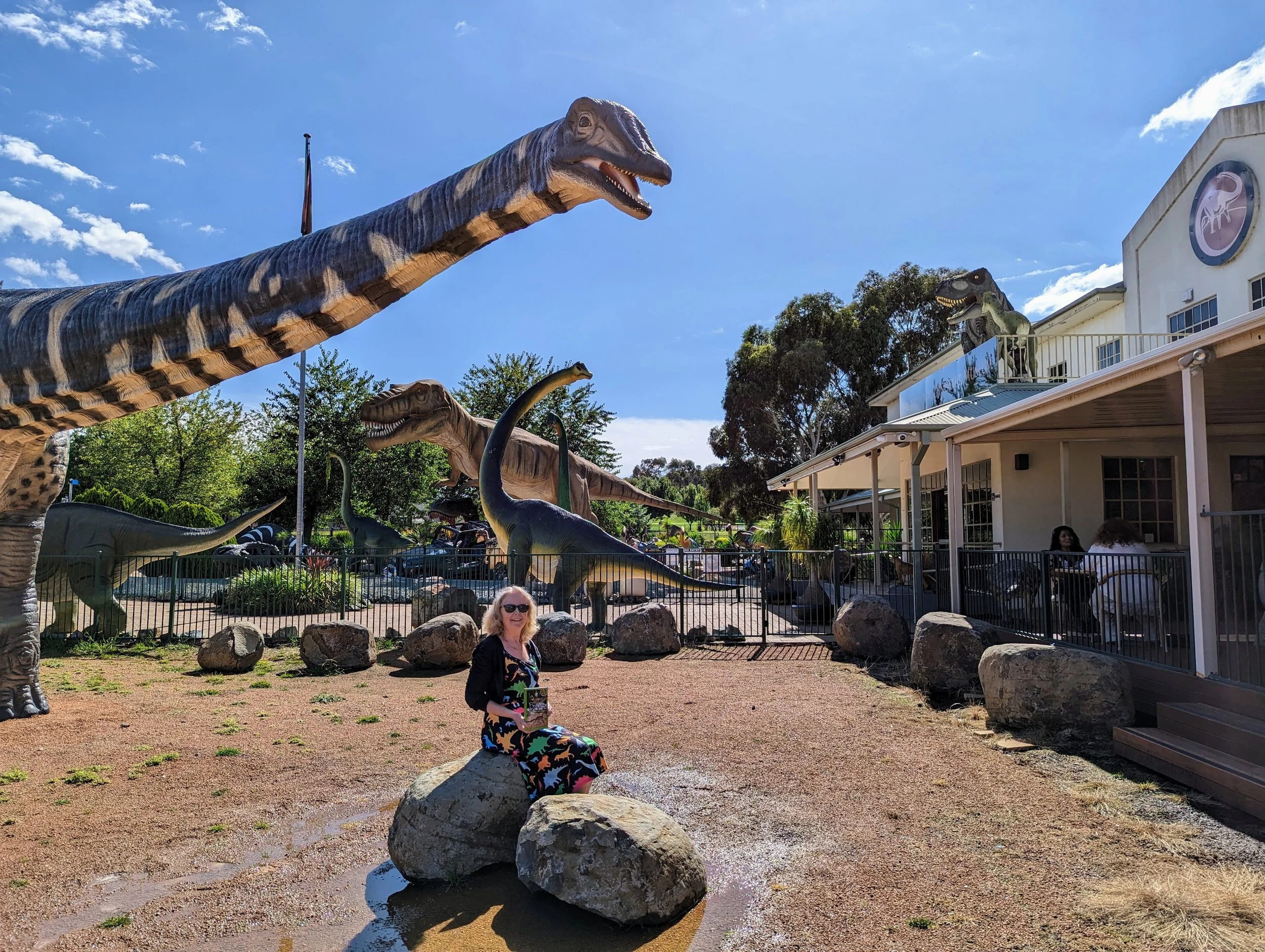
Head and long neck of a replica of Australotitan Coopernesis at the National Dinosaur Museum with me, Sandra Bennett Author sitting underneath holding a copy of Fossil Frenzy, the Adamson Adventures 3.
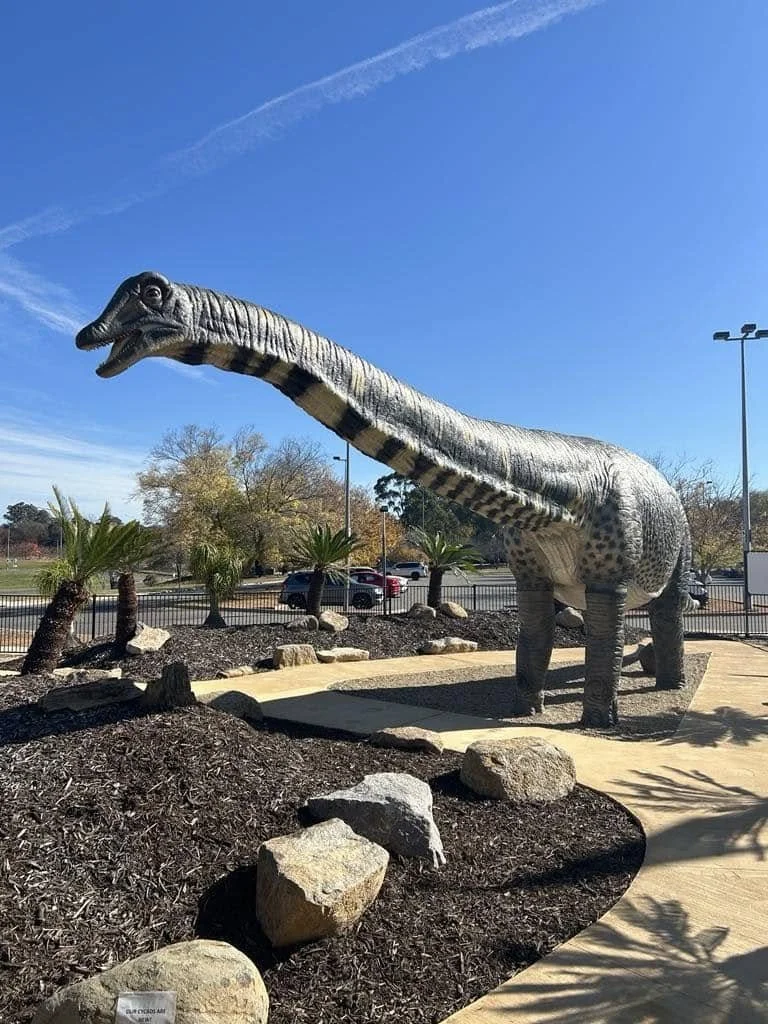
Australotitan Cooperensis at the National Dinosaur Museum.
Australotitan Cooperensis - found in outback Queensland west of the small town of Eromanga, with a tiny population of around 100 people. Cooper was found in the dry Eromanga basin which was an inland sea during the Early Cretaceous period. Initially discovered only in 2005-7, the remains of Cooper have proven to be the largest titanosaurian sauropod in Australia. He was believed to have been about 30m (98.42 ft) long and 6.5 m (21.32 ft) high from ground to hip, so that doesn’t include that remarkably long neck and tiny head. Australotitan Cooperensis fossilised remains can be found at the Eromanga National History Museum.
Muttaburrasaurus - this plant eating ornithopod ( a mostly bipedal dinosaur known to have bird-like feet), was found on a farm near a town called Muttaburra in Central Queensland which is another small town with a population of only 200 people. Muttaburrasaurus was also from the Early Cretaceous period. It measured 7 - 9 m (23 -30 ft) in length, stood 2.3-2.6 m (7.5 -8.5 ft) tall to the hip and weighed about 3 tons. Muttaburrasaurus is know for its unusually shaped head and long, rounded snout.
Australovenator -is a mega-raptor found in the dry outback plains near Winton, in the central west of Queensland, which is a slightly larger town with a population of around 860 people. This raptor was 6 m (19.38 ft) long and 2 m (6.5 ft) tall at the hip. This carnivorous dinosaur lived during the late Cretaceous period. The most well known Australovenator was discovered on the edge of a dried out billabong (watering hole) alongside a sauropod. They were named Banjo and Matilda in honour of Banjo Paterson who wrote the well-know poem Waltzing Matilda while living in the Winton region. Banjo and Matilda can be found at the Australian Age of Dinosaurs Museum just outside of Winton.
Minmi paravertebra - Discovered in 1969 in a place called Minmi in Central Queensland near the town of Roma, which has a population around 6,800. This Minmi is the first ankylosaur (armoured dinosaur) to have been discovered in the Southern Hemisphere. It was also around during the Early Cretaceous period. It was a herbivore that walked on all four long legs with backwards directed bony projections similar to a crocodile. These would have strengthened their muscles and would have made it possible to outrun some predators rather than relying on their spiky bone structure for defence alone. The minmi has been measured as a small dinosaur at 2.5 - 3 m , (8.2- 9.8 ft ) long, stood only about 1 m (3.28 ft) tall to the hip and weighed 300 Kg (660 lb).
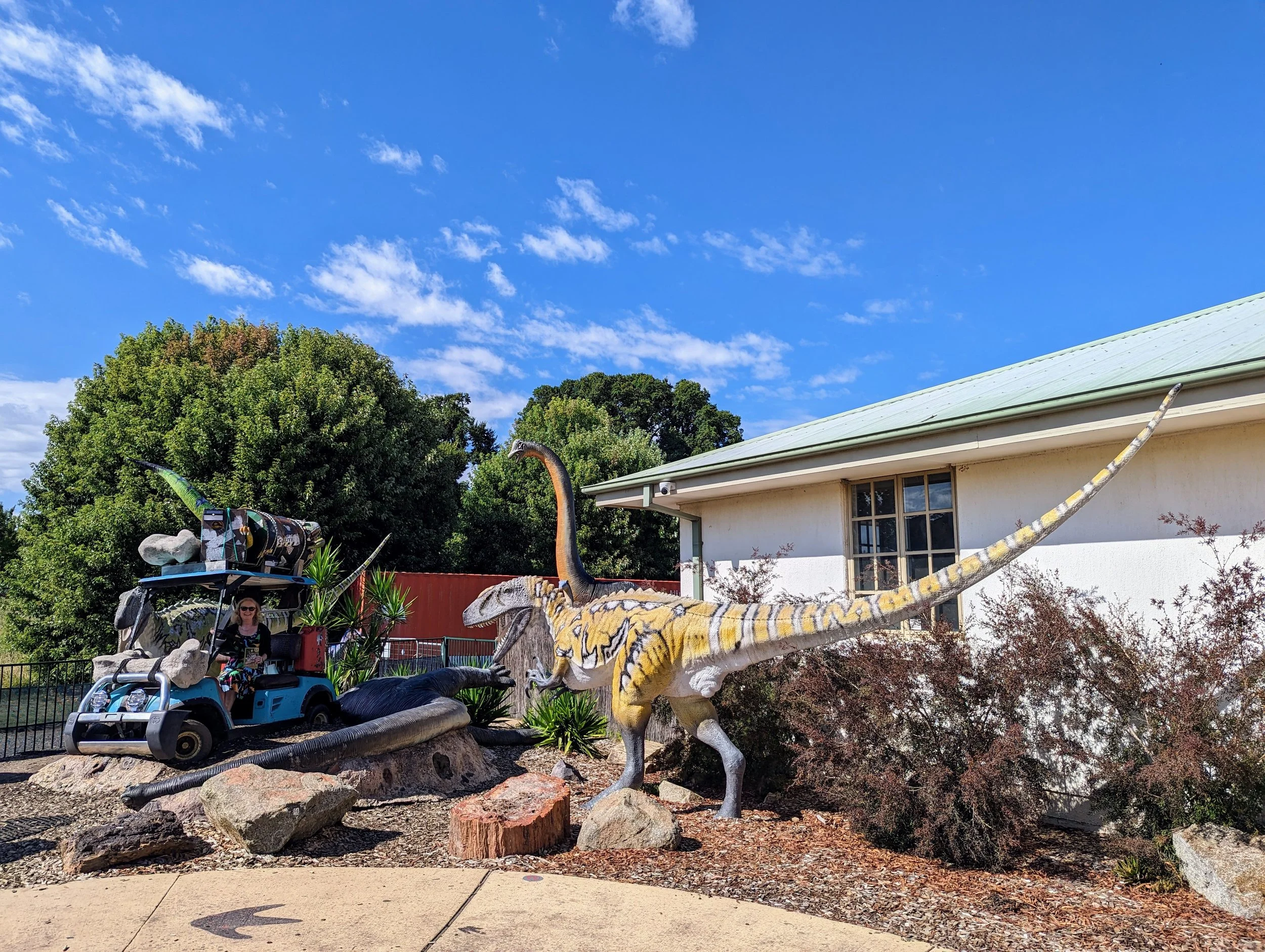
A replica of Australovenator at the National Dinosaur Museum, Me, Sandra Bennet Author sitting in the Jurassic Park like jeep holding a copy of Fossil Frenzy.
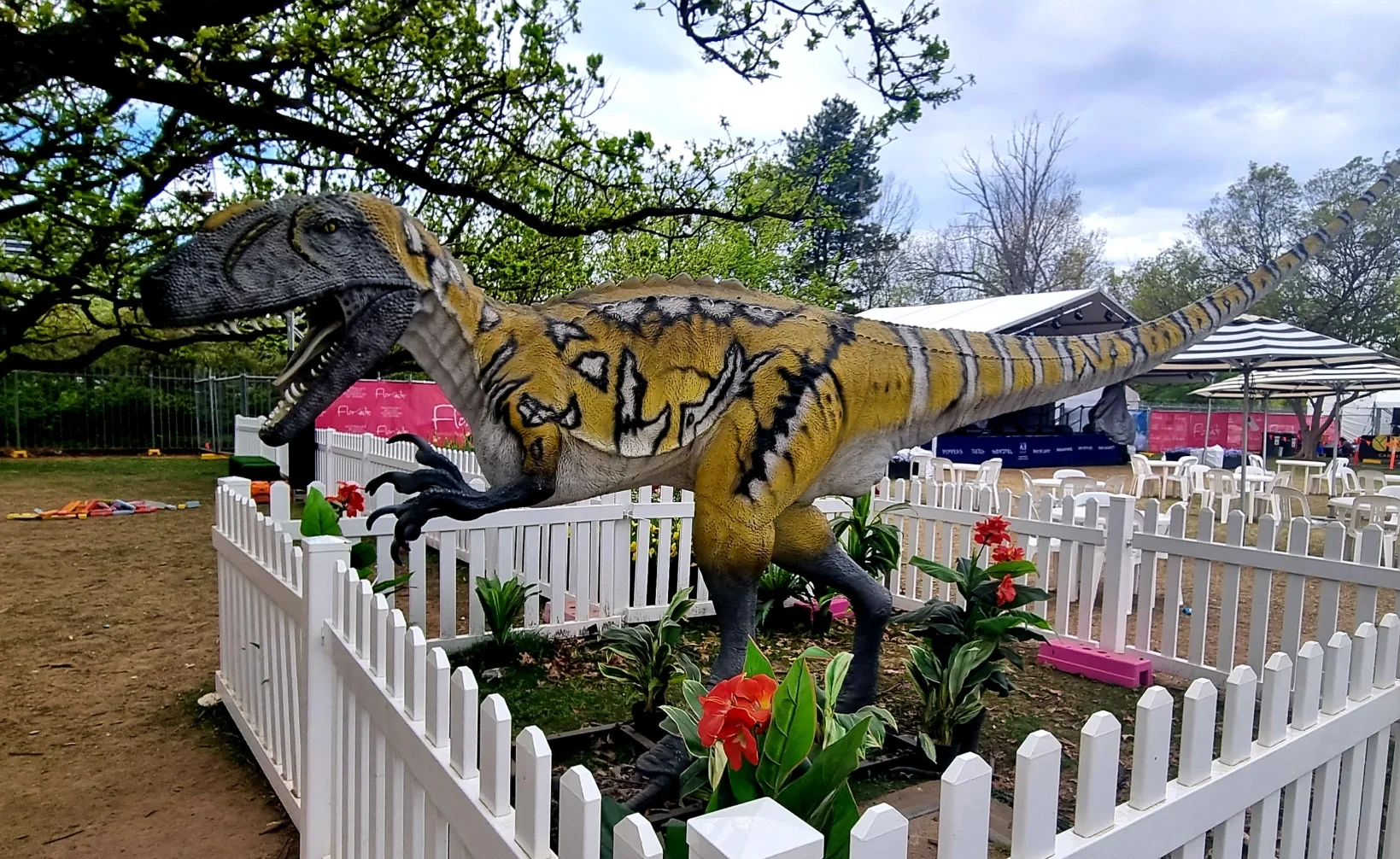
Australvenator at Floriade in Canberra 2025, courtesy of the National Dinosaur Museum.
Replicas of these dinosaurs may also be seen at the Australian National Dinosaur Museum here in Canberra. You can also find information on Australian Dinosaurs in the museums of any Australian state museum. Dinosaur Valley at Scenic World in Katoomba in the Blue Mountains (west of Sydney), is a fun way to explore dinosaurs while walking through native bushland. More dinosaurs can be found among the rainforest walk at the Daintree Discovery Centre in far North Queensland. I was lucky to have an opportunity to experience both these amazing walks while researching Fossil Frenzy.
Both the Minmi paravertebra and the Australovenator can be found in Fossil Frenzy The Adamson Adventures 3. When reading the story kids will see that I have simplified the text to mega-raptor and ankylosaur, but for those interested in learning more, they will find information at the back of the book. Long neck sauropods are also found in the story, however I have not made reference to Australotitan Cooperensis specifically.
If you are interested in an outback dinosaur adventure in Queensland, you can embark on Australia’s dinosaur trail which covers 1,350Km that includes The Australian Age of Dinosaurs Museum at Winton, Dinosaur Stampede National Monument at Lark Quarry Conservation Park, Kronosaurus Kornerat Richmond where you can see lots of marine dinosaur fossils, and at Hughendon you can discover the Muttaburrasaurus at Flinders Discovery Centre. Of course if you can’t manage a real life outback Queensland adventure, you can always read Fossil Frenzy from the comfort of you own home.
What is your favourite dinosaur?
Why do you think kids find them so fascinating?