#adventure

Celebrating National Dinosaur Day, May 7.

This week on Thursday 7th May, we celebrate National Dinosaur Day. here in Australia. Queensland celebrates National Dinosaur Week beginning Monday 4th May. The U.S. celebrate national dinosaur day on 1st June, while International Dinosaur day is 20th May. I thought this was a perfect time to revisit some of Australia’s unique dinosaurs and of course my chapter book Fossil Frenzy the Adamson Adventures 3.

I know I promised I would write this month on the Realities of Self-Publishing part 3, but I hope you forgive me in my indulgence of our incredibly roaresome extinct wildlife.

Let’s look first at why kids are often obsessed with dinosaurs.

  1. The fact that dinosaurs are extinct and lived millions of years ago in a world very different from our world today creates mystery , intrigue and wonder which in turn makes them irresistible for imaginative play.

  2. Dinosaurs are often depicted as scary huge animals that spark curiosity.

  3. During play they can explore issues of fear and bravery in a safe but fun environment.

  4. Dinosaur names are often long and tricky to pronounce and spell making them too alluring not to attempt.

  5. There is a large diversity of types of dinosaurs to explore and develop curiosity for learning.

The benefits of having a fascination for dinosaurs.

  1. The obvious one, learning to write, read and pronounce tricky or complex dinosaur names increases vocabulary growth during their younger informative years. it not only strengthens phonetic awareness but verbal skills and increases language development.

  2. Children develop a longer attention span due to their high level of interest to focus on a given topic. With so many other distractions these days, we need to encourage anything that will help our kids increase their focus and attention span.

  3. When kids study a particular topic like dinosaurs they develop the ability to comprehend complex subjects and information which helps in later learning.

  4. By categorising dinosaurs by species, habitat or diet children increase their ability to process critical thinking skills and ideas that later help in the learning of STEM subjects.

  5. Children often have much more knowledge of dinosaurs than their parents which gives them confidence as they master and become experts in a given subject.

  6. Shared interaction playing with dinosaurs or sharing knowledge about dinosaurs helps children connect socially with peers and adults.

A few Australian Dinosaurs and where to find them.
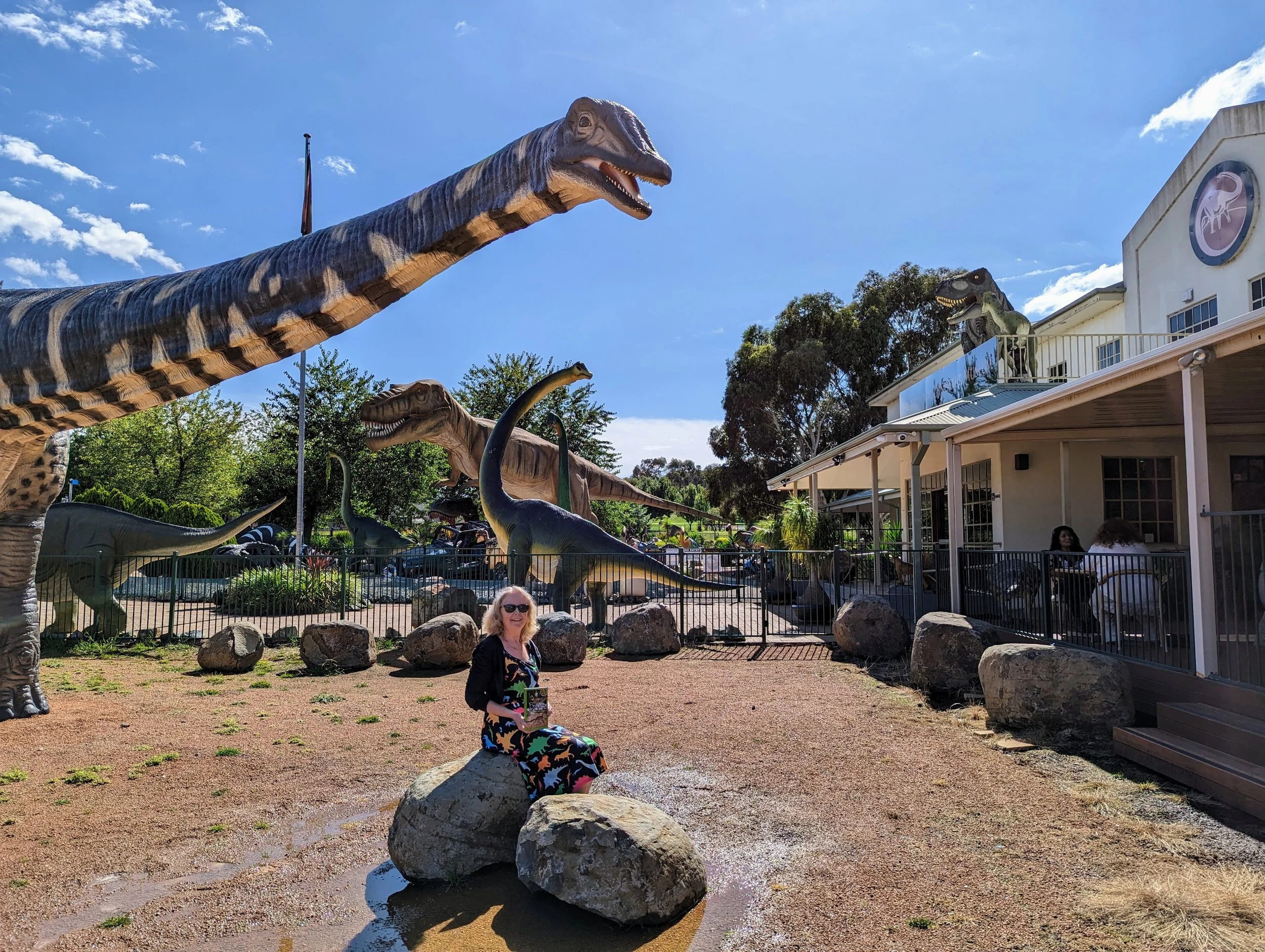
Head and long neck of a replica of Australotitan Coopernesis at the National Dinosaur Museum with me, Sandra Bennett Author sitting underneath holding a copy of Fossil Frenzy, the Adamson Adventures 3.
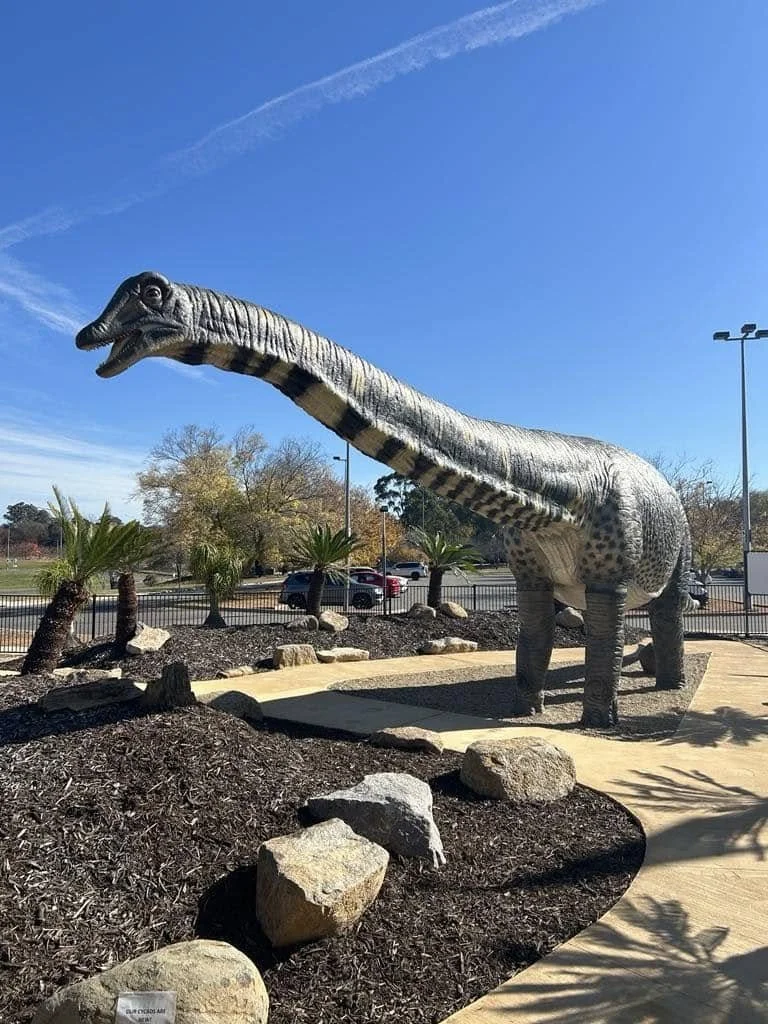
Australotitan Cooperensis at the National Dinosaur Museum.

  1. Australotitan Cooperensis - found in outback Queensland west of the small town of Eromanga, with a tiny population of around 100 people. Cooper was found in the dry Eromanga basin which was an inland sea during the Early Cretaceous period. Initially discovered only in 2005-7, the remains of Cooper have proven to be the largest titanosaurian sauropod in Australia. He was believed to have been about 30m (98.42 ft) long and 6.5 m (21.32 ft) high from ground to hip, so that doesn’t include that remarkably long neck and tiny head. Australotitan Cooperensis fossilised remains can be found at the Eromanga National History Museum.

  2. Muttaburrasaurus - this plant eating ornithopod ( a mostly bipedal dinosaur known to have bird-like feet), was found on a farm near a town called Muttaburra in Central Queensland which is another small town with a population of only 200 people. Muttaburrasaurus was also from the Early Cretaceous period. It measured 7 - 9 m (23 -30 ft) in length, stood 2.3-2.6 m (7.5 -8.5 ft) tall to the hip and weighed about 3 tons. Muttaburrasaurus is know for its unusually shaped head and long, rounded snout.

  3. Australovenator -is a mega-raptor found in the dry outback plains near Winton, in the central west of Queensland, which is a slightly larger town with a population of around 860 people. This raptor was 6 m (19.38 ft) long and 2 m (6.5 ft) tall at the hip. This carnivorous dinosaur lived during the late Cretaceous period. The most well known Australovenator was discovered on the edge of a dried out billabong (watering hole) alongside a sauropod. They were named Banjo and Matilda in honour of Banjo Paterson who wrote the well-know poem Waltzing Matilda while living in the Winton region. Banjo and Matilda can be found at the Australian Age of Dinosaurs Museum just outside of Winton.

  4. Minmi paravertebra - Discovered in 1969 in a place called Minmi in Central Queensland near the town of Roma, which has a population around 6,800. This Minmi is the first ankylosaur (armoured dinosaur) to have been discovered in the Southern Hemisphere. It was also around during the Early Cretaceous period. It was a herbivore that walked on all four long legs with backwards directed bony projections similar to a crocodile. These would have strengthened their muscles and would have made it possible to outrun some predators rather than relying on their spiky bone structure for defence alone. The minmi has been measured as a small dinosaur at 2.5 - 3 m , (8.2- 9.8 ft ) long, stood only about 1 m (3.28 ft) tall to the hip and weighed 300 Kg (660 lb).
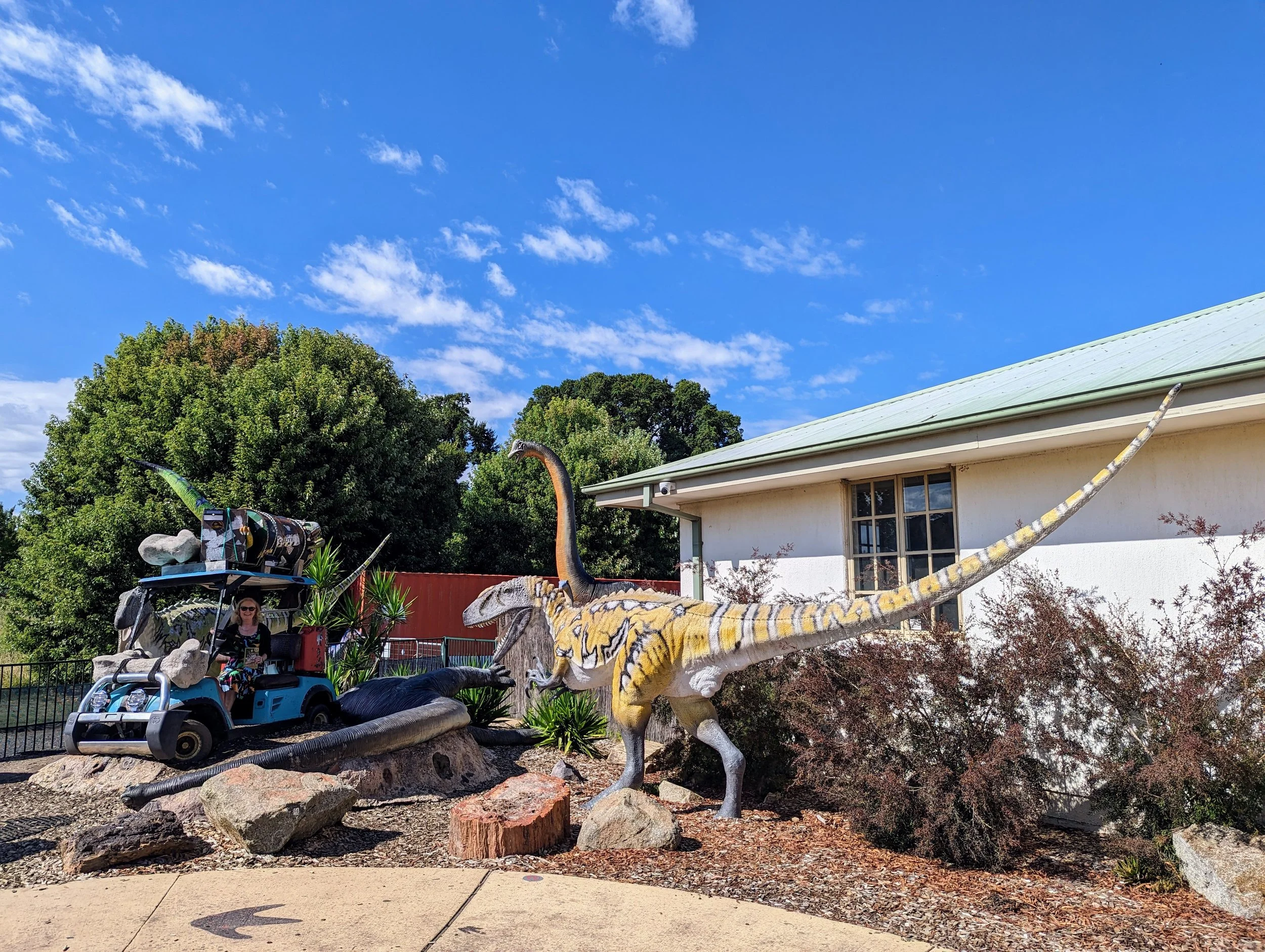
A replica of Australovenator at the National Dinosaur Museum, Me, Sandra Bennet Author sitting in the Jurassic Park like jeep holding a copy of Fossil Frenzy.
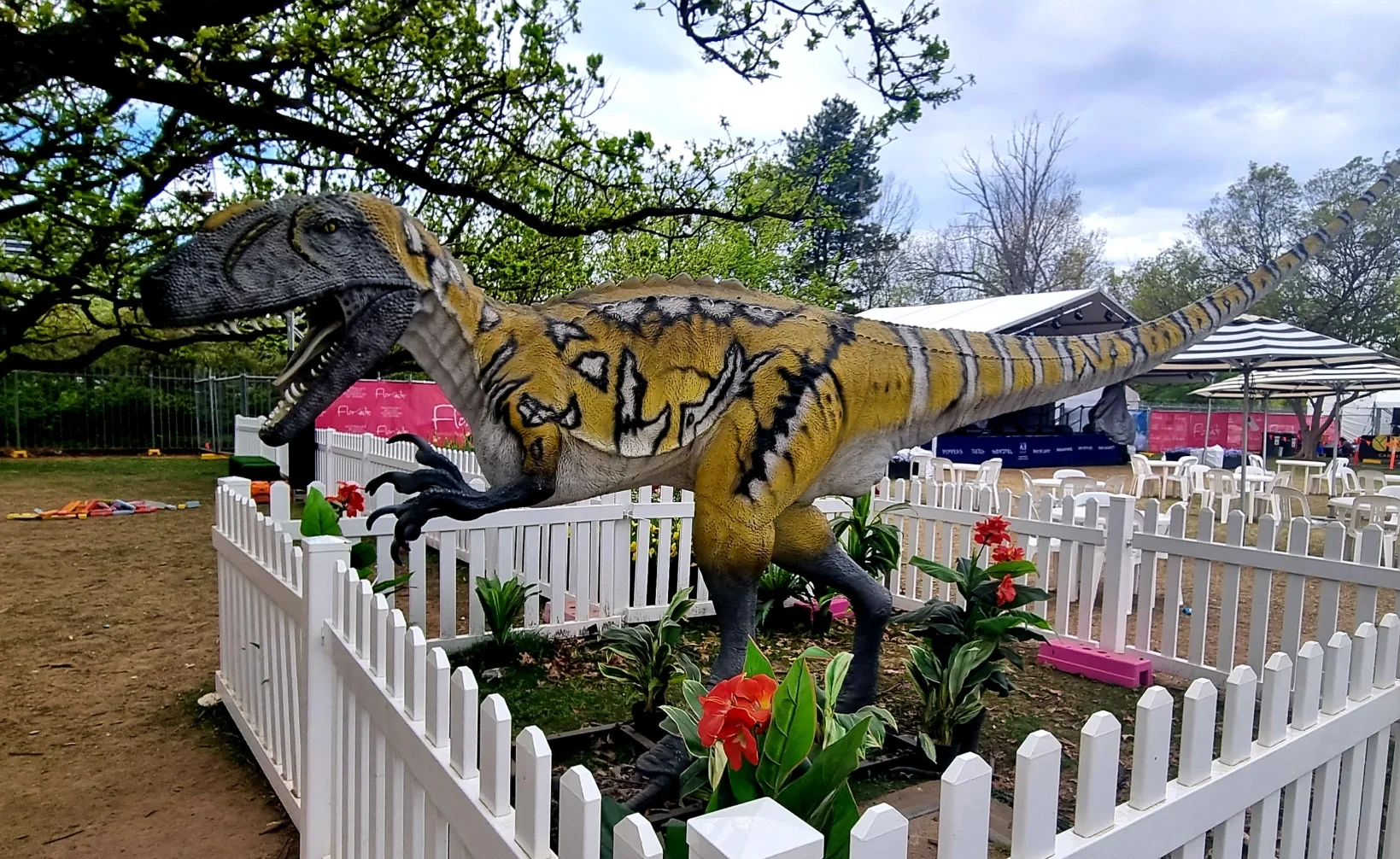
Australvenator at Floriade in Canberra 2025, courtesy of the National Dinosaur Museum.

Replicas of these dinosaurs may also be seen at the Australian National Dinosaur Museum here in Canberra. You can also find information on Australian Dinosaurs in the museums of any Australian state museum. Dinosaur Valley at Scenic World in Katoomba in the Blue Mountains (west of Sydney), is a fun way to explore dinosaurs while walking through native bushland. More dinosaurs can be found among the rainforest walk at the Daintree Discovery Centre in far North Queensland. I was lucky to have an opportunity to experience both these amazing walks while researching Fossil Frenzy.

Both the Minmi paravertebra and the Australovenator can be found in Fossil Frenzy The Adamson Adventures 3. When reading the story kids will see that I have simplified the text to mega-raptor and ankylosaur, but for those interested in learning more, they will find information at the back of the book. Long neck sauropods are also found in the story, however I have not made reference to Australotitan Cooperensis specifically.

If you are interested in an outback dinosaur adventure in Queensland, you can embark on Australia’s dinosaur trail which covers 1,350Km that includes The Australian Age of Dinosaurs Museum at Winton, Dinosaur Stampede National Monument at Lark Quarry Conservation Park, Kronosaurus Kornerat Richmond where you can see lots of marine dinosaur fossils, and at Hughendon you can discover the Muttaburrasaurus at Flinders Discovery Centre. Of course if you can’t manage a real life outback Queensland adventure, you can always read Fossil Frenzy from the comfort of you own home.

What is your favourite dinosaur?

Why do you think kids find them so fascinating?

Five Fascinating Animals of Tasmania

This past month I have been steadily working away on the back matter for book four of the Adamson Adventures.

Yes, it’s been a long time in between book 3 and four, but I hope it’s worth the wait.

I don’t want to say too much about it just yet, except that I plan to release it in June next year. There’s still much to do before then.

For this one, besides drawing a map as usual, which helps the reader see where the story is set, I decided to include illustrations and information about each animal that is mentioned in the story. I’m no illustrator, but I do like to give drawing a try, so I have been brave to attempt these myself and share them with you now. I also shared them one at a time each day on my Instagram and Facebook pages, but in case you missed any of them, here they are all in one place.

Thylacine

No story set in Tasmania would be complete unless it included the Thylacine, (Tasmanian Tiger). Presumed extinct since 1936 when the last one died in captivity in a Hobart zoo, I like to imagine that this elusive carnivorous marsupial is still hidden out in the vast, thick wilderness somewhere. Will the Adamson kids find one in their next adventure? If you've read any of their previous adventures, you know anything is possible.

 The Tassie Tiger was hunted into extinction by farmers who saw it as a threat to their livestock. Now the Thylacine is being hunted for a different reason. Today people search in the hope that it does still exist out there somewhere. As it was the largest apex predator in Tasmania the Thylacine has left a huge gap in the balance of the forest ecosystem. Today the largest predator is the Tasmania Devil which cannot compare in size. Researchers are trying to use DNA samples to bring back the Thylacine and reintroduce it into the wilderness in the hope that it will restore the balance of life and reduce and control the populations of kangaroos and wallabies.

Thylacine image courtesy of Australian Geographic archives.

My sketch of the Thylacine, commonly known as the Tasmanian Tiger.

Tasmanian Devil

Below is a Tasmanian Devil, a nocturnal, carnivorous marsupial that prefers to scavenge for its food rather than hunt. They have very sharp claws and teeth and make incredibly loud raspy screams when they fight. Have you ever seen one in the wild or in a zoo? Last year when we visited Tasmania, we were lucky to catch a glimpse of two devils in the wild. I couldn’t take a photo, they disappeared into the bush very fast when they saw us.

However, it was an amazing experience to see them in the wild. I have only ever seen them in a zoo before. These little critters are listed as endangered with numbers depleting quickly due to a cancerous facial tumour which has been spreading fast throughout the population in the wild. Fortunately, there is a conservation breeding program happening on the Australian mainland in the mountains of northern NSW. called Devil Ark, where the increasing numbers of devils are enjoying the similarities in vegetation and climate to Tasmania without any threat from disease.

Tasmanian Devil in the wild.

My sketch of the Tasmanian Devil.

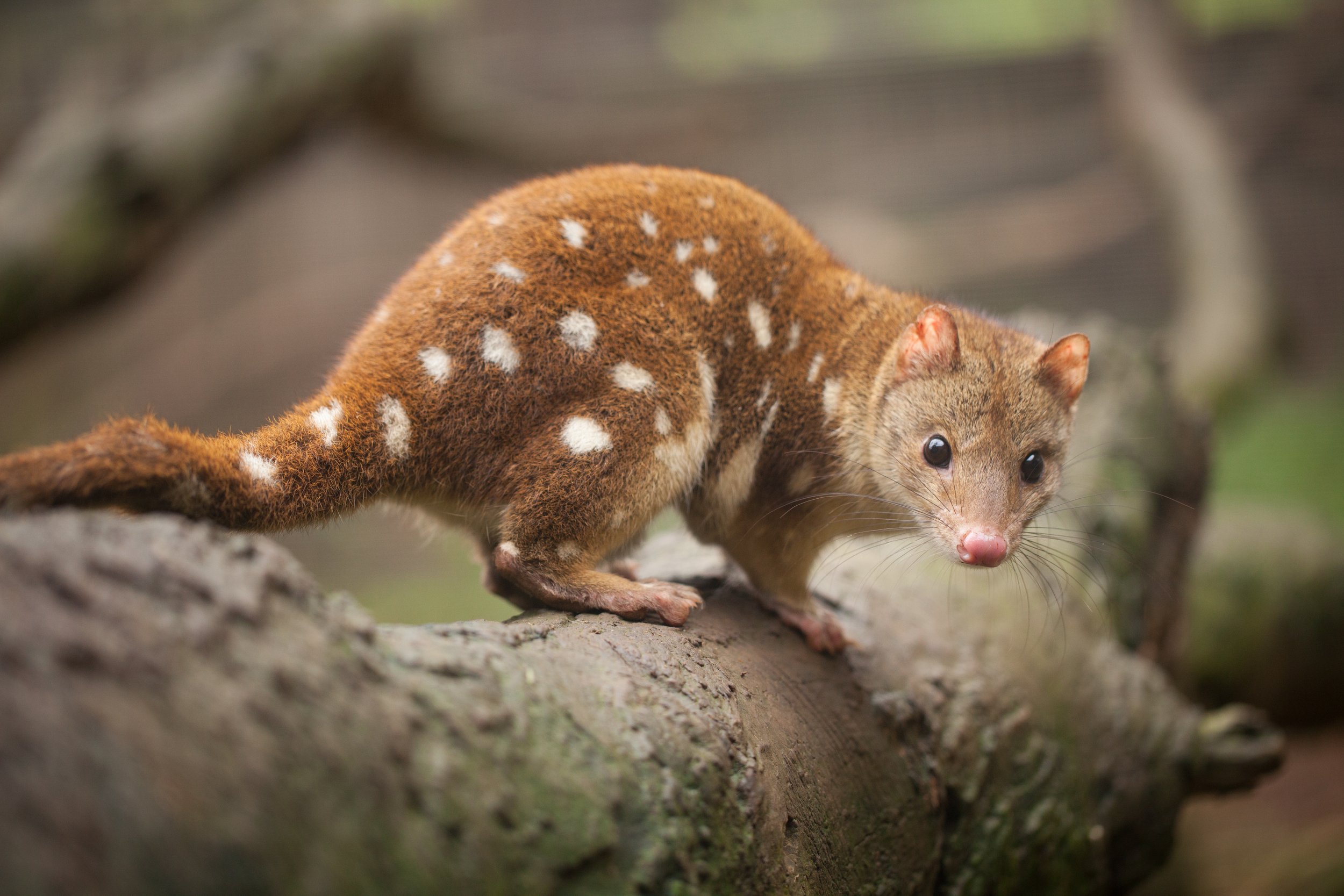
Spotted Quoll

The Spotted-Tail Quoll, also known as the Tiger Quoll, is a relative of the Tasmanian Devil and the Tasmanian Tiger. Like his relatives he is also a nocturnal carnivorous marsupial. He may look cute, but watch out for those very sharp teeth. Quolls can be found on mainland Australia, where they are listed as endangered. while so far in Tasmania they are listed as vulnerable. There is only a population of around 14,000 quolls left throughout Australia.

Their numbers have drastically reduced due to introduced predators such as foxes and feral cats, deforestation from logging, land clearing for housing development and natural bushfires.

Spotted Quoll - WWF Australia

My sketch of the Spotted Quoll

Pademelon

The cute little Tasmanian Pademelon is much like a kangaroo or wallaby but smaller. It has a shorter neck and a thicker, rounder body. Pademelons can be found in the rainforests all around Tasmania and throughout the mainland even as far north as Papua New Guinea.. We encountered several during our bushwalks and even outside our cabin door at Cradle Mountain.

They live in thick damp forests but will come out into clearings to feed in the evenings. However with regular land clearing we are continually reducing their chances of survival. Pademelons are usually solitary creatures, but will forage at night in groups. An interesting fact about these little fellows is that when startled, a pademelon will thump his foot, (much like the rabbit, Thumper from the Bambi movie) to alarm the rest of the group to hop back to the safety of the thick forest.

I took this photo of a pademelon just outside our cabin at Cradle Mountain,

My sketch of a Pademelon.

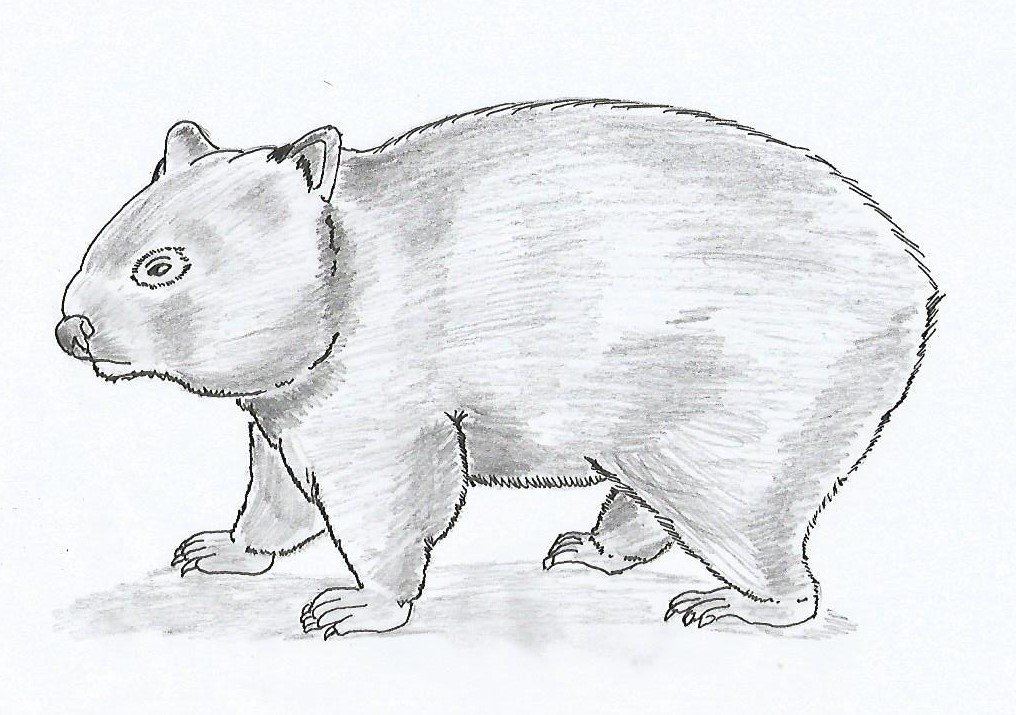
Wombat

The Common Wombat is in abundance throughout Australia, however the Southern and Northern Hairy Nose Wombat are much more declined in numbers. Wombats found in Tasmania are smaller than common wombats and their fur is much thicker and softer than the wiry fur of a common wombat.

Did you know that these herbivorous marsupials have a backwards pouch? This is to protect their joey from the dirt that spays up as they dig their burrow. Wombats are one of my favourite Australian animals, we even have one that has made its home under a container at the back of our house. If the opening to the burrow gets any bigger, I fear our container will fall in! Wombat burrows are usually closer to creek beds and water sources, but in years when rain is plentiful, they will move further away.

A fun fact that I recently learnt is that wombats glow in the dark when you shine a UV light on them. Scientists suspect the reason for this bio luminescence is so that wombats can see each other in the dark and know when it is safe to come closer to a fellow wombat instead of another animal that they would prefer to keep at a distance.

Southern Hairy-Nose Wombat

My sketch of a wombat


Stay tuned for more information next month on the birds that are also in book 4 of the Adamson Adventures.

I enjoy adding fact and information pages to the back of my stories. It helps curious young readers learn and hopefully encourages them to research further. Did you learn something new today?

What is your favourite Australian animal?

Writing Adventure Stories With Kids.

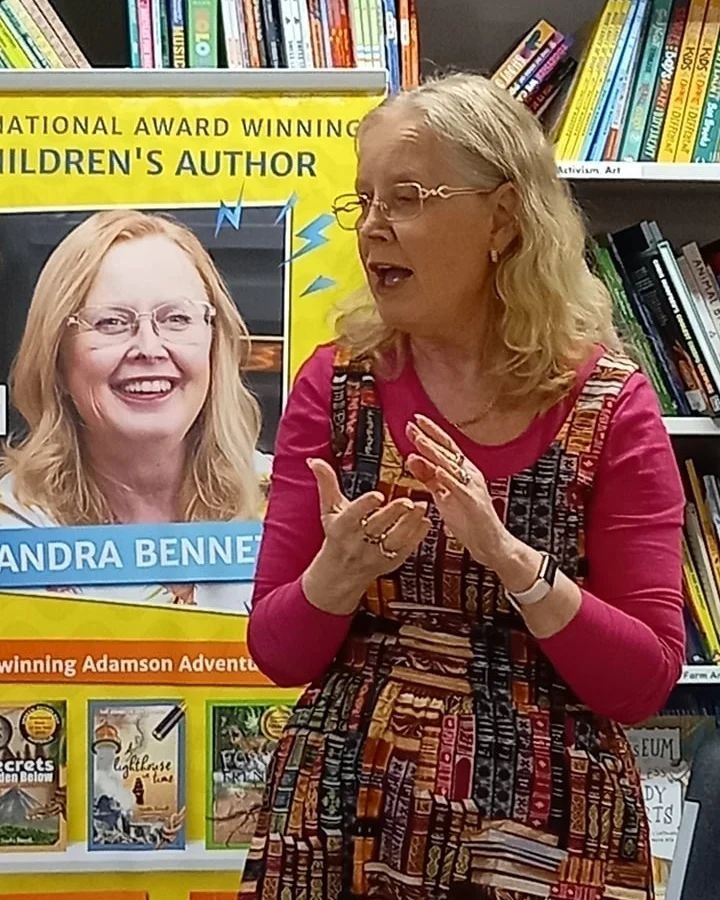
Yesterday I had the great pleasure of presenting a writing workshop to a group of kids. It was for the very first kids book club organised by the amazing and supportive Book Cow-Kingston.

Running a writing workshop for kids at the Book Cow Kingston for their Kids Book Club.

There’s always so much fun to be had when talking about adventure stories, dinosaurs and volcanoes.

We decided that instead of asking kids to read a certain book or chapters before attending the event, all they had to do was to think about an adventure story they had read.

The question was then posed - What makes a great adventure story?

We spent the next hour or so, discussing the key elements that go into writing the story structure to develop their own fantastic adventure.

To do this yesterday, as we went through each item, I used examples and read extracts from my Adamson Adventure series. This lead to much discussion about dinosaurs and volcanoes. (more on that later).

Let’s examine seven key features we need to be able to write a thrilling adventure story for kids.

A Hero

All great stories need an equally great hero or protagonist. The hero needs to be likeable and relatable so that the reader will be invested in the story and want to see the hero succeed. A hero, also however, needs flaws or weaknesses. Things that they fear or worry about that they must attempt to overcome throughout the story.

My main character in the Adamson Adventures is Zac. Each story is told from his point of view. Zac is a bit of a know it all. He loves reading, science and learning about everything, but this can be a little annoying to his siblings. Zac’s knowledge about dinosaurs does come in handy to help keep them out of danger in Fossil Frenzy.

Supporting Characters

A hero often doesn’t go on his journey alone, (although he can) he usually needs supporting characters or sidekicks. These provide comic relief when the tension gets too much, or push the hero to keep moving forward when the obstacles get too difficult.

Zac’s sidekicks are his sister, Clare and his brother, Luke. They too, need to have good and bad traits. Clare started out quite shy and frightened in Secrets Hidden Below, book 1, she didn’t like to take risks or do anything that might get herself and her brothers in trouble. By Fossil Frenzy, book 3, her character has grown, become much more confident and self assured, in fact you might even say that she becomes the unwilling hero. Luke on the other hand, is the spontaneous sibling, who likes to rush into things without thinking. This could be seen as either good or bad. On one hand, he is never afraid to try new things, or not paralysed by self doubt, but it can lead him into inevitable danger where Zac and Clare must follow to protect him.

A Quest

All adventure stories have a quest or journey in one form or another. Whether that is in solving a mystery, searching for a treasure or resolving some sort of major problem. Within the quest, their must be an inciting incident that drives our characters forward to a point of no return. They have no other choice but to head deep into the chasm of difficulty and danger. It is always good to drive them into an unfamiliar or perilous environment.

In Fossil Frenzy, the kids are on a quest to find fossils to help save their Uncle’s drought-stricken farm. The inciting incident occurs when the massive storms converge and they are forced to take shelter in a cave, only to discover when they emerge that they are no longer in their own time.

Villains

This brings us to the baddies in our story or the antagonist. This can come in many forms. It could be another person, it could be a crippling fear that prevents the hero from achieving his goals, or it could be a threatening animals. In this case it is a dinosaur, a theropod to be exact that is not only chasing them, but preventing them from finding a way safely back home.

Risks

As the quest continues, we must up the tension with more and bigger risks. Their must be perils to face that become harder to avert or resolve.

We talked about different types of dinosaurs, which ones may be herbivores or carnivores and what dangers these may lead our characters into. I read an extract from Fossil Frenzy and we decided whether the Demon Duck of Doom was most likely a friend or foe.

Time Limit

A great adventure also needs a time limit. It also increases the suspense, pace, drama and pressure as our heroes race against the clock to succeed. In Fossil frenzy, not only are they in imminent danger from carnivorous dinosaurs, they are running out of food and Luke becomes critically ill making the trio desperate to return home to get him to hospital.


Transformation

By the end of the journey the hero must have changed in some way by the time he has achieved his goal. Zac is more grateful to have his siblings by his side and has come to realise the importance of family. Clare is more courageous, although at times still somewhat reluctantly, while Luke, is now starting to consider his actions before diving in headfirst.


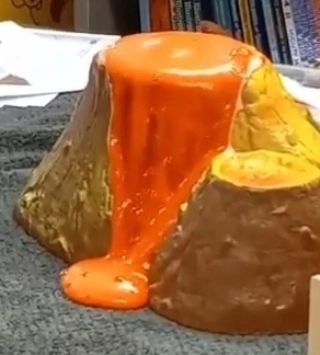
Other than dinosaurs, I also used as an example a volcano. It could be seen as a setting or a villain, depending on how and where in the story it is used. I read an extract from Secrets Hidden Below where the volcano appears in the climax of the story. It is antagonistic and prevents our heroes from seemingly achieving their final goal. It is not until the resolution that we find out whether or not they have found the sought after pirate treasure. To demonstrate the use of the volcano as part of a setting, and the initial action, I read from my early reader ‘Alien Shenanigans’ where the volcano is a classroom experiment that goes inevitably and drastically wrong. To the delight of the book club, I did the experiment and erupted the volcano. It was a fantastic way to finish the session and one I am sure the kids will remember.

The volcano began to fizz and slowly ooze over the sides.

An erupting volcano is always a big hit with kids.

Do you like reading adventure stories?

What is one of your favourites that you read as a child?

All my books mentioned above are available here from my website.

What I Have Learnt As A Writer That Can Also Help you.

If there is one thing I have learned over all the years I have been writing, it is as Aristotle is famous for saying - ‘The more you know, the more you know you don’t know.’

A quote from Aristotle that is apt in all that we learn. Thanks to azquotes for this image.

I admit I have gained some worthwhile knowledge in my writerly journey but there is always so much more out there to learn and share. Here are a few tips that I now know and wish I new earlier.

When writing a blog post, make it helpful to the reader.

Mix it up a little.

Write posts that will help readers gain information. They will be more interested to read further if you assist in their learning about something of their interest. Pique interest with anecdotes about yourself but don’t make it all about you. Even in my earliest blogs I wrote about topics to help others.

In one of my original blogs back in 2013 I wrote about the Classic Middle Child Syndrome

While it was an attempt to discuss the characters in my first self-published book Gingerbread Aliens, it was also a way of helping my readers understand the differences of each sibling in their family and the importance of treating each sibling as unique individuals.

The next post was also an attempt to help families with a light-hearted look at our neighbours and how to live in a community together without living in each others pockets. Curiosity Killed the Cat

Looking back on these, I realised I started off my blog writing journey in the right manner, but somehow lost my way for a while and forgot this important message. Today I now know the importance of making sure I am focussed on my reader. If I were to write these now, I would have written them slightly differently. I should have used my characters as examples to make my point after my discussion, not the other way around.


Gingerbreadaliens can be found here


Dot points/Headers and links.

Readers like to scroll.

Remember your reader is often time poor and will only glance at your post. You need to give them a reason to pause and read further. Dot points and headers draw attention to the point you are making.

Embedded links are important for your SEO. They provide pathways to help reach a larger audience.

You can see in the two above early blog posts that I neglected to do either of these.

Photos/Images.

Images whether they are your own or found online are another way to help your reader pause and consider what you have to say. Add links to the original source if it doesn’t belong to you and make sure it isn’t copyright bound.

Publishing Takes Time.

While Gingerbread Aliens was the first book I self-published, it was not the first story I wrote.

I remember my first ever piece I had published was a poem I wrote when I was sixteen. It won a state-wide writing competition and was published in a magazine. I was so proud of that piece, yet after all of these years I have no record of it. I do not have the original hand written poem, nor do I have a copy of the magazine publication. I have written to NSW RSL in hope that they may have had it archived, but had no luck in receiving a response. My advice here, is to always keep a copy of your writing, you never know when you might want to revisit it.

A Good Story Needs to Percolate.

It can take a long time from original idea to publication.

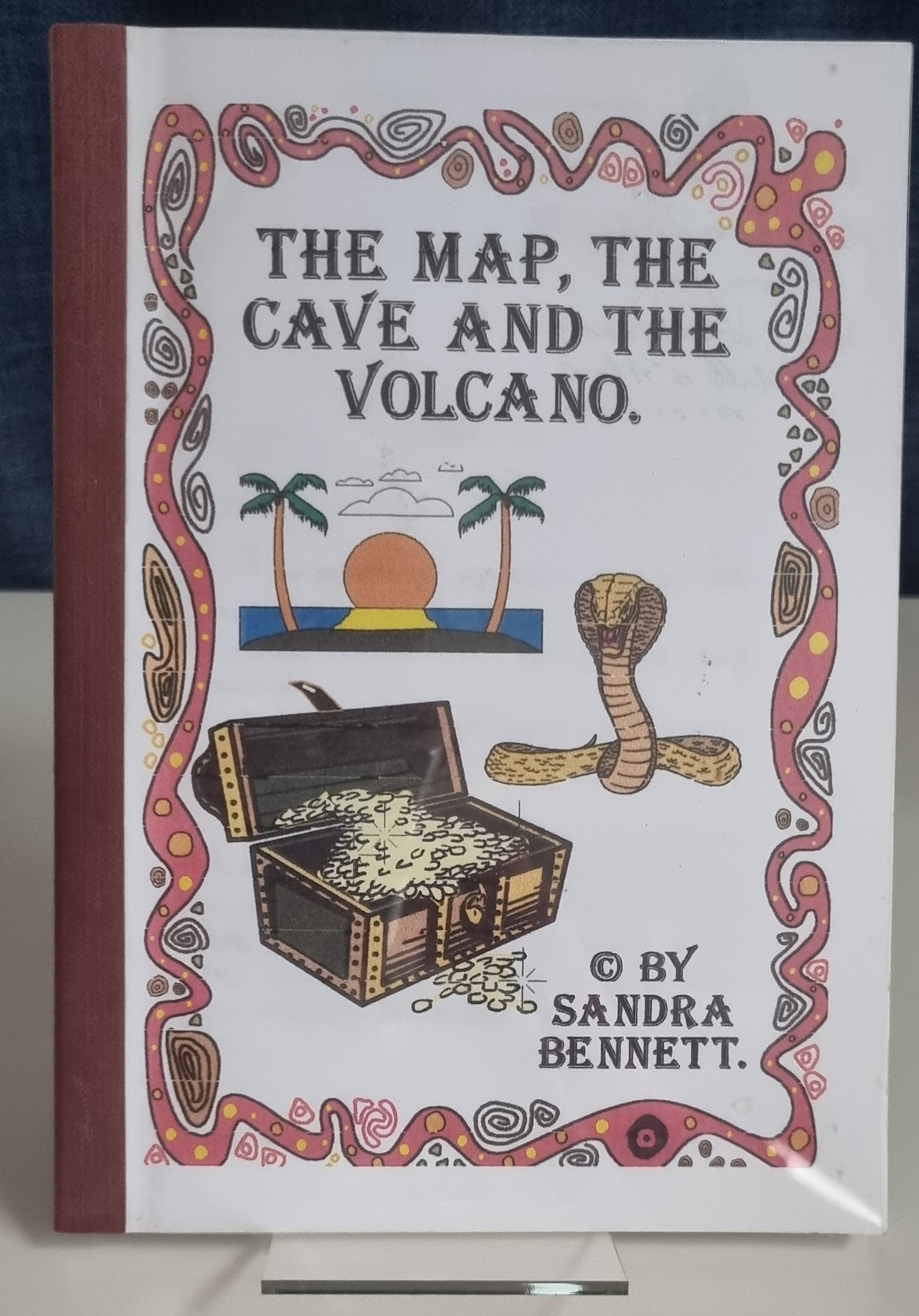
When I first wrote Secrets Hidden Below it began with a different title, - ‘The Map, the Cave and the Volcano.’ At that stage I thought it was ready for publication and even found some interest with publishers. Sadly it didn’t make it through acquisitions , which was probably a good thing as I eventually made many improvements to the original story. Not knowing anything about self-publishing back then, I had a handful printed through Officeworks and gave copies to my family members. I am glad that is all I did , as I allowed it to sit in a drawer for years while I learnt more about the craft of writing and eventually produced a story that was traditionally published and won a shortlisted award in the Australian Speech Pathology Awards 2019. My patience, persistence and commitment paid off in the end.

Don’t rush your story, allow it to take time to germinate properly, edit and rewrite until you can make it the best story you can. Then have a professional editor help you. Never be afraid to ask for help and be prepared to listen to advice.

A copy of my original story, “The Map, The Cave and The Volcano.’ that finally became Secrets Hidden Below

You can find more information about Secrets Hidden Below here.

I am sure there is so much more I could share, but another thing I have learned is not to make my blog posts too long.

I hope you have found this not only interesting, but helpful too.

What is one particular thing that stands out to you that you have learnt over the years. Please comment below.

To read more about what some other authors have learnt since their early days writing, please click on the links below.

3 Ways Writing Made Me a Better Person by Julie Gorges

What I've Learned as a Writer by Rosie Russell